
Queen Anne’s Lace - Discernment
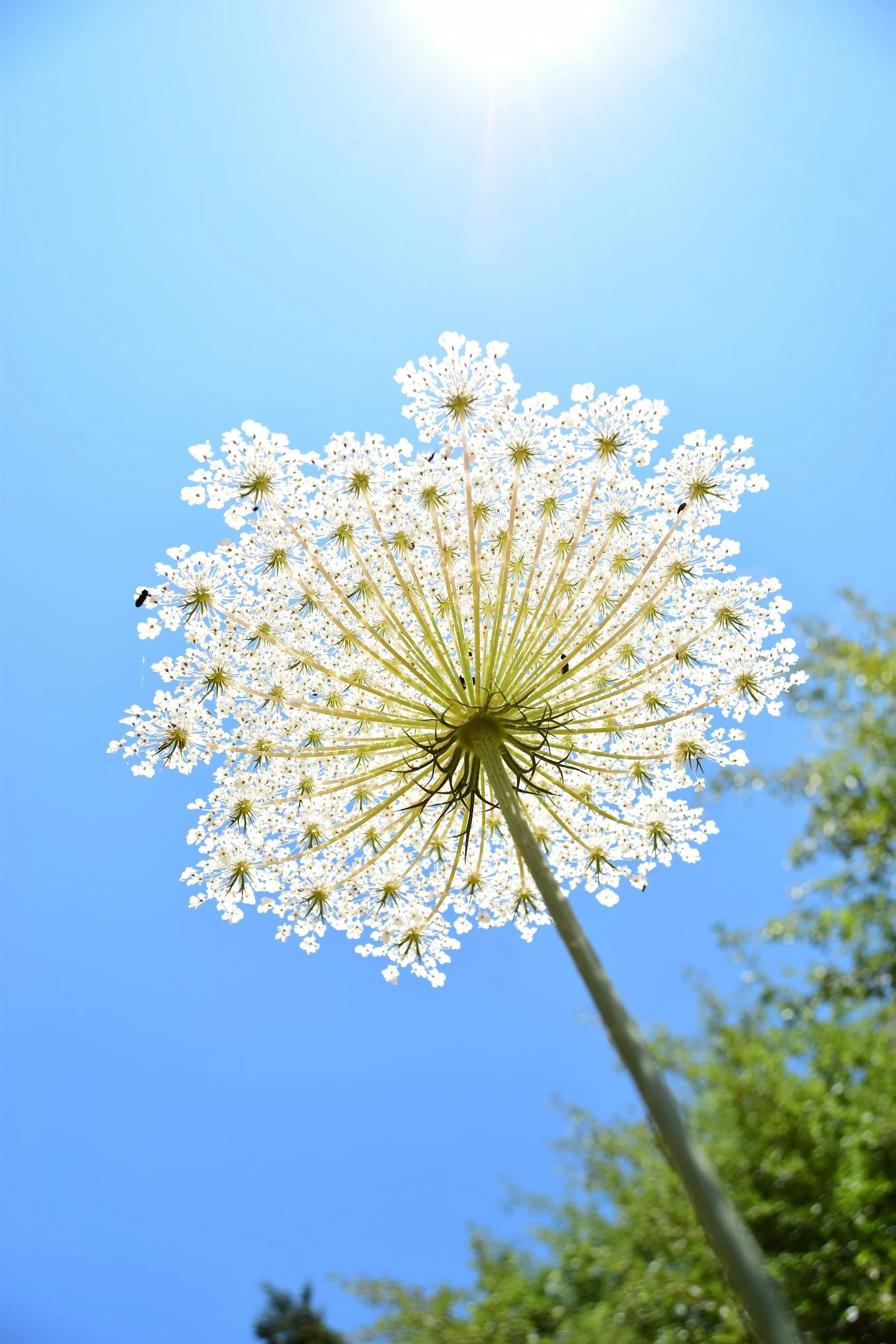
Botanical Name: Daucus Carota
Herbal Actions: diuretic, carminative, reproductive regulator.
Chakra Energy: Third Eye (6th/Ajna)
Parts Used: Do not forage this plant for internal use.
Queen Anne’s Lace rises from summer fields and roadsides on slender stems, her tiny white flowers gathered into broad, intricate umbels that really do resemble lace. Also known as wild carrot, Daucus carota belongs to the Apiaceae family alongside parsley, fennel, dill, celery, and our familiar garden carrot.
This “wild carrot” is an ancestor of our cultivated carrot. Long before carrots became the large, sweet orange roots we know today, their wild relatives produced much smaller, paler, more fibrous roots. Over generations, people selected plants for larger and more tender roots, eventually giving us the cultivated carrots we now grow and eat.
Her common name has its own bit of folklore. One story says the flower was named for Queen Anne because its delicate white blossoms resembled the lace she made. The tiny dark flower sometimes found in the center was said to represent a drop of blood from the Queen pricking her finger with her needle. It is a lovely story, although its historical origins are uncertain.
She also has a long history as an herbal plant. Wild carrot was described by ancient Greek and Roman writers, including the first-century physician Dioscorides. Through the centuries, different parts of the plant have been used as food and in traditional herbal preparations.
Her seeds have been particularly valued by herbalists. Aromatic and slightly warming, they have traditionally been used to support digestion, encourage urination, and support the urinary system. Wild carrot seed also has a long and complicated history in women’s reproductive medicine, where it has been used traditionally to influence menstruation and fertility. These historical uses are interesting, but they should not be interpreted as established modern contraceptive or reproductive care.
The young root is edible when properly identified and carries the unmistakable scent of carrot. Unlike the tender cultivated carrot, however, wild carrot roots become increasingly woody and fibrous as the plant matures.
Perhaps the most important thing to know about Queen Anne’s Lace, however, is how to identify her. She belongs to a botanical family containing several plants with remarkably similar white umbrella-shaped flowers, including poison hemlock (Conium maculatum), which can be fatal if ingested and cause an intense skin rash just by brushing against it.
The flowers of the queen are worth looking at closely. Noticing how each broad flower head is actually composed of many tiny individual blossoms. And maybe you will see that single deep burgundy or purple flower that appears near the center. As the flowers mature and seeds develop, the entire umbel begins curling inward, eventually forming the characteristic little “bird’s nest” seen in late summer and fall.
One of Queen Anne’s Lace’s most recognizable features setting her apart from poison hemlock is her green hairy stem and fern like leaves. An old foraging mnemonic makes this wonderfully difficult to forget:
“The Queen has hairy legs”
Poison hemlock has smooth, hairless stems, commonly with distinctive purple or reddish blotches.
No single feature, however, should ever be used to identify a wild edible or medicinal plant. Habitat, leaves, stems, flowers, growth pattern, scent, and other botanical characteristics should all agree before identification is considered certain.
For this reason, Queen Anne’s Lace is not a plant I would recommend casually gathering for the herbal medicine cabinet. She is a beautiful herb to learn and recognize, but any wild plant intended for food or medicine should be identified with complete confidence—especially when potentially deadly look-alikes share the same landscape.
Reflection
Queen Anne’s Lace has been growing beside humans for centuries—as food, medicine, ancestor to one of our most familiar vegetables, and simply as a wild plant filling summer fields with white.
What changes when you learn the name and story of a plant you may have walked past hundreds of times before?
How can she help us practice discernment? See the different between very similar beautiful plants, one poisonous the other a gift.
Simple Ritual
If you find Queen Anne’s Lace growing on your next walk, leave the plant where it is and spend a few minutes studying her.
Look at the tiny individual flowers that create the larger blossom. Find the fine hairs along the stem. Notice whether there is a dark flower in the center. If the plant has begun setting seed, look for the flower head curling inward into its little bird’s nest.
Rather than harvesting her, simply practice knowing her.
A Note of Caution
Queen Anne’s Lace can be confused with poison hemlock and other toxic members of the Apiaceae family. Never consume a wild plant based on photographs, an app, or one identifying characteristic alone.



The leaves and flowers are edible and have a fresh, peppery flavor reminiscent of watercress, mustard, or radish. The flowers are beautiful scattered over salads, while the young leaves can be added to sandwiches, chopped into savory dishes, or blended into pesto.