
Psoas, Breath, & Anxiety - A Nervous System Conversation
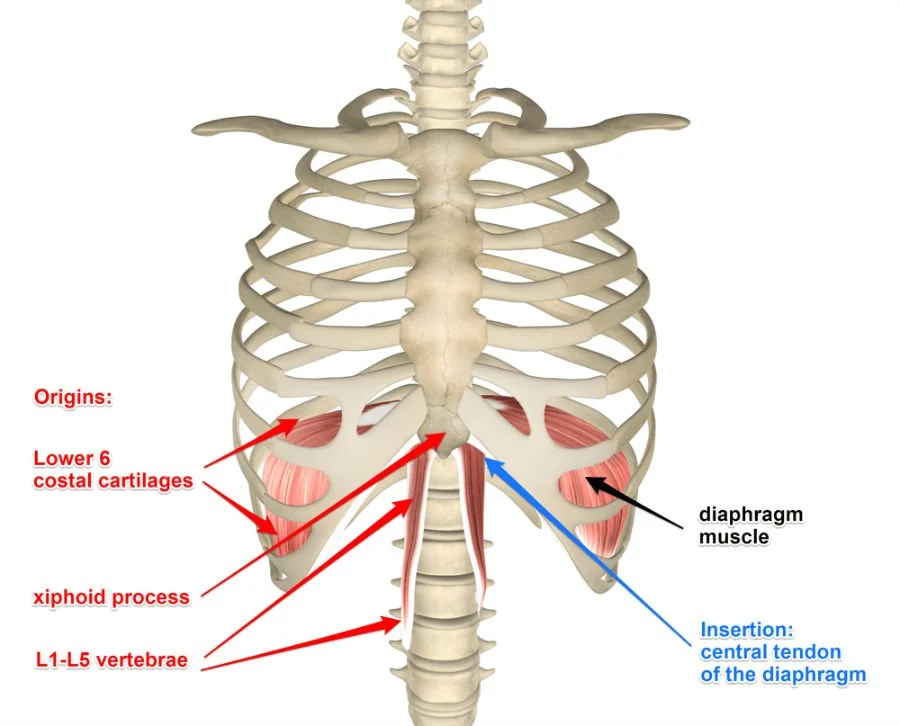
The psoas and the diaphragm are deeply connected — anatomically, neurologically, and functionally. Together, they sit at the crossroads of breath, posture, and survival response. Understanding their relationship helps explain why anxiety so often feels physical, and why gentle approaches can be so effective.
The Diaphragm
The diaphragm is the primary muscle of breathing. It separates the chest from the abdomen and moves with every inhale and exhale. Beyond respiration, it plays a key role in nervous-system regulation through its close relationship with the vagus nerve.
When the diaphragm moves freely, breath is spacious and adaptable. This movement also creates gentle internal pressure that helps support the spine and signal safety to the body.
That sense of safety is communicated in part through the vagus nerve — a major pathway between the body and brain. The vagus nerve carries information about breath, heart rate, and internal state upward, helping the nervous system recognize when it’s safe enough to soften.
The Psoas
The psoas is a deep core muscle connecting the spine to the legs. It responds quickly to perceived threat and prepares the body to move, brace, or protect. Under stress, fear, or prolonged vigilance, it often tightens unconsciously.
The psoas doesn’t misbehave — it listens for cues of safety and stability.
(Read more about the psoas here)
How Breath and the Psoas Influence Each Other
The diaphragm and psoas share fascial connections along the lumbar spine. When breath becomes shallow or held, the diaphragm’s downward movement decreases. This reduces internal support around the low back.
In response, the nervous system recruits the psoas to provide stability. The psoas subtly shortens or braces to protect the spine and prepare the body for action. Over time, this increased tone can limit the diaphragm’s ability to descend fully.
A pattern may form:
shallow breath → psoas bracing → more restricted breath
This isn’t pathology. It’s patterning.
Anxiety Through a Body Lens
When the body perceives threat — whether immediate, subtle, or remembered — it organizes around protection rather than ease.
The diaphragm may shift toward rapid or upper-chest breathing. The psoas prepares for holding or movement. The body stays ready.
This is why anxiety often feels like:
Tight hips or low back
Difficulty taking a full breath
A sense of being “held together”
Restlessness paired with fatigue
The body is doing its job.
Why Gentle Work Matters
Forcing release — through aggressive stretching or pushing the breath — often reinforces vigilance. The nervous system receives the message that something is wrong and needs fixing.
Gentle approaches offer different information:
Slow exhale invites the diaphragm to soften
Supportive positions allow the psoas to feel held rather than stretched
Awareness without demand signals safety
When breath begins to feel safe again, the psoas no longer needs to brace so strongly. Release happens as a consequence, not a command.
A Simple Reframe
The psoas is not the problem.
The diaphragm is not the fix.
They are in conversation.
When breath feels safe, the body listens.
And when the body listens, it doesn’t need to shout.
Do Thoughts Come First?
We often assume anxiety begins with a thought — worry, anticipation, or memory. And sometimes that’s true.
But the nervous system doesn’t work in a straight line.
Breath, muscle tone, and autonomic state can shift before conscious thought appears. A shallow breath, subtle bracing in the body, or a sensory cue may occur first — and the mind may arrive later, trying to make sense of the sensation.
In this way, thoughts are not always the cause of anxiety. Sometimes they are the interpreter.
Anxiety is not a single origin story. It’s a conversation between body, breath, environment, and mind.
This is why we don’t always have to know why the body is bracing. Sometimes allowing gentle release is enough.
A Gentle Invitation
If you’re curious to explore this relationship in your own body, the psoas practice offered here is not about stretching or fixing. It’s an invitation to slow down, soften the breath, and let the body feel supported.
Through gentle positions, longer holds, and an emphasis on the exhale, the practice offers the nervous system new information: that it’s safe enough to let go, even slightly.
You don’t need to force release. You don’t need to understand everything.
You can simply listen — and allow the body to respond in its own time
This psoas practice is offered as an audio through the Monthly Pause — a free, once-a-month offering with reflections and calming tools to support nervous-system ease.
You’re welcome to join if it feels supportive.



Humans question things. We wonder why something happened, what something means, whether what we have been told is true, and sometimes even about the nature of reality itself.